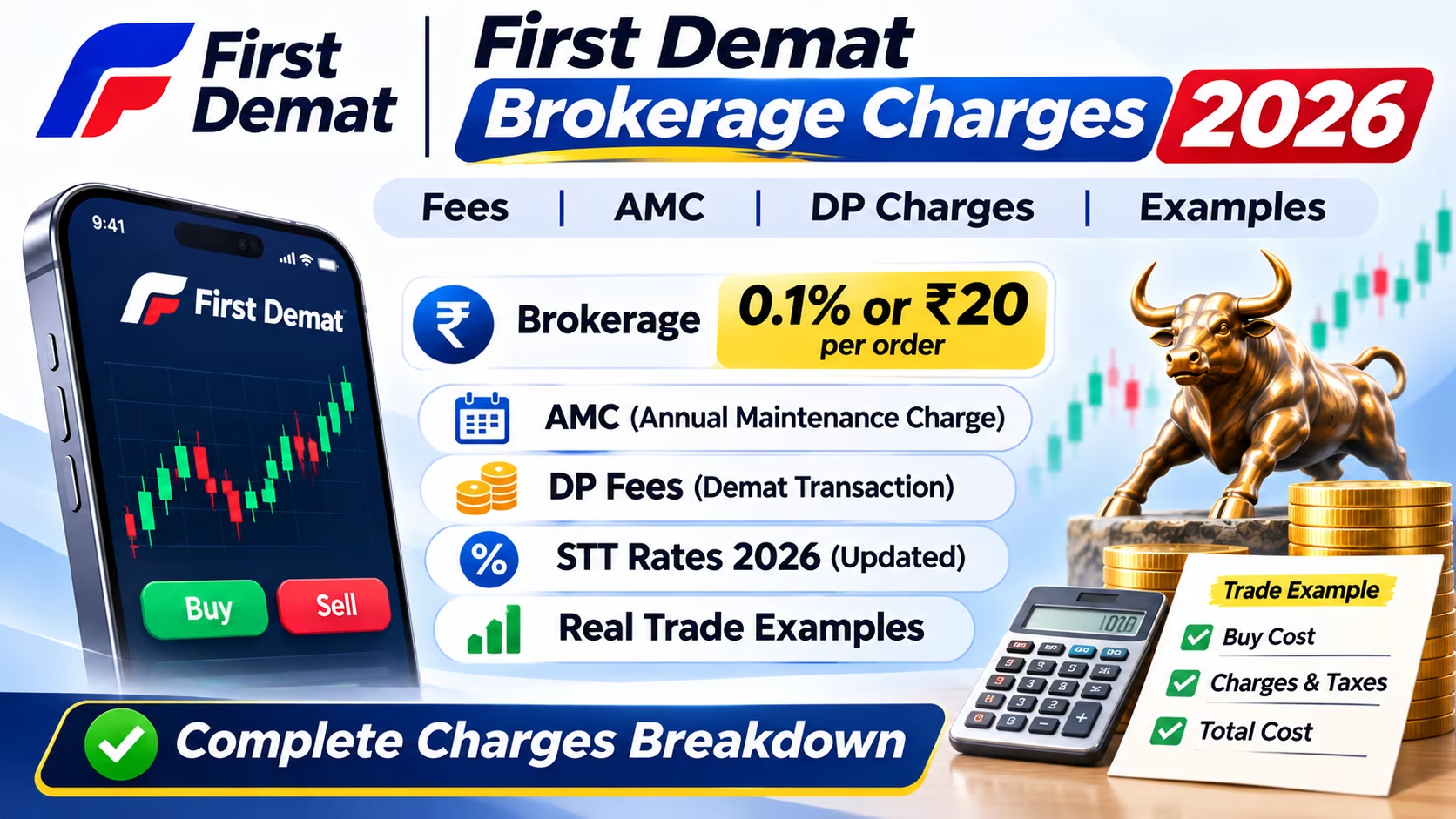
"Flat ₹20 per order" sounds simple until you open your first contract note and see eight different lines of charges. I have been there, and it is the moment most new traders realise brokerage is only one slice of what they pay.
This guide breaks down First Demat brokerage charges line by line for 2026. Not just the headline number, but the AMC, DP fees, penalty charges, the new STT rates that kicked in on 1 April 2026, and — most usefully — five real trade examples that show the exact rupee amount you would pay on delivery, intraday, options and futures trades. By the end, you will know whether First Demat is actually cheap for the way you trade.
First Demat Charges List 2026: Snapshot
|
Charge type |
First Demat fee |
|---|---|
|
Equity delivery brokerage |
0.1% or ₹20 per executed order, whichever is lower |
|
Equity intraday brokerage |
0.1% or ₹20 per executed order, whichever is lower |
|
Futures brokerage |
Flat ₹20 per executed order |
|
Options brokerage |
Flat ₹20 per executed order |
|
Account opening (online) |
₹0 |
|
Account opening (offline) |
₹500 |
|
AMC |
₹0 in year one; later rate not published |
|
Call & trade / auto square-off |
₹50 per trade |
|
DP charge on selling |
₹20 + GST per ISIN (as per broker listings) |
Before the Numbers: Who You Are Paying
First Demat is run by AS Bullishify Private Limited, a Ranchi-based discount broker incorporated in June 2024. It holds SEBI stock broker registration INZ000328330 and lists NSE member code 90479 and BSE member code 6952. MCX membership is also stated, though the member code is not published.
Its demat accounts are offered with NSDL under DP ID IN303921, through Ashlar Securities Private Limited. Grievances can go to SEBI SCORES or the Smart ODR portal if the broker does not resolve them.
Why this matters for charges: Because the DP service is provided through a partner, some demat-related fees may follow the partner's tariff. That is one reason the DP charges are worth confirming directly before you sell your first holding.
First Demat Brokerage Charges by Segment
The brokerage model is the same idea across segments: you never pay more than ₹20 per executed order. In cash equity, you can pay less if your order is small.
|
Segment |
Brokerage |
What it means in practice |
|---|---|---|
|
Equity delivery |
0.1% or ₹20 (lower) |
Not free. ₹10,000 order = ₹10 |
|
Equity intraday |
0.1% or ₹20 (lower) |
₹20 on most normal-sized trades |
|
Equity futures |
Flat ₹20 |
Same for 1 lot or 10 lots in one order |
|
Equity options |
Flat ₹20 |
Per executed order, buy or sell |
|
Commodity F&O |
From ₹20 |
MCX access; verify member code first |
|
Currency F&O |
Not offered |
— |
How "0.1% or ₹20, Whichever Is Lower" Actually Works
The break-even point is ₹20,000. Any order below that value pays 0.1%. Anything at or above ₹20,000 pays the flat ₹20.
|
Order value |
0.1% of value |
Brokerage you pay |
|---|---|---|
|
₹2,000 |
₹2 |
₹2 |
|
₹8,000 |
₹8 |
₹8 |
|
₹20,000 |
₹20 |
₹20 |
|
₹75,000 |
₹75 |
₹20 (capped) |
|
₹5,00,000 |
₹500 |
₹20 (capped) |
One detail people miss: brokerage applies on both legs. A buy and a sell are two executed orders. So a round trip on a ₹50,000 position costs ₹40 in brokerage, not ₹20.
First Demat Account Opening Charges and AMC
Opening an individual account online costs nothing. If you go the paper route, it is ₹500. Accounts for partnerships, LLPs and companies are marked "coming soon".
There is no annual maintenance charge for the first year. The problem is what comes after: the official pricing page does not state the year-two AMC. Industry AMCs usually fall in the few-hundred-rupee range, but you should not guess. Ask support for the figure in writing at the time you open the account, so you are not surprised twelve months later.
First Demat DP Charges, Pledge and Demat Services
Every time you sell shares from your demat account, a DP (depository participant) charge applies per company (ISIN), per day. It does not depend on quantity, so selling 1 share or 1,000 shares of the same stock on the same day costs the same.
|
Demat service |
Charge (as per broker listings) |
|---|---|
|
DP charge on debit (sell) |
₹20 + GST per ISIN |
|
Margin pledge / unpledge |
₹25 + GST per transaction |
|
Margin pledged |
₹3 + GST per transaction |
|
Dematerialisation |
₹20 per request + ₹3 per certificate |
|
Failed instruction |
₹20 per instruction |
Full transparency: First Demat's own pricing page had an empty "Demat Services" section when I checked. The figures above come from independent broker databases, so treat them as indicative and confirm with the broker.
Extra Charges That Catch Traders Off Guard
These are the charges that do not show up on the homepage banner but absolutely show up on your ledger.
|
Charge |
Amount |
How to avoid it |
|---|---|---|
|
Auto square-off |
₹50 per trade |
Close intraday positions yourself before cut-off |
|
Call & trade |
₹50 per trade |
Keep the app logged in; use it for emergencies only |
|
Order in debit balance |
₹50 per order (not ₹20) |
Never trade with a negative ledger |
|
Delayed payment |
0.05% per day |
Clear shortfalls the same day |
|
Physical delivery (F&O) |
0.5% of contract value |
Exit stock F&O before expiry |
|
Physical contract note |
₹50 + courier |
Stick to email contract notes |
|
KYC modification |
₹50 |
Get details right at onboarding |
Trader insight: The 0.5% physical delivery charge is the most expensive surprise on this list. On a stock futures contract worth ₹5 lakh, that is ₹2,500 — more than 100 times the normal ₹20 brokerage. If you trade stock options or futures, set a calendar reminder to exit before expiry day.
Statutory Charges in 2026 (Same at Every Broker)
These are levied by the government, exchanges and SEBI. First Demat collects them, but it does not keep them, and they are the same whichever broker you choose.
|
Charge |
Delivery |
Intraday |
Futures |
Options |
|---|---|---|---|---|
|
STT |
0.1% buy & sell |
0.025% sell |
0.05% sell |
0.15% sell (premium) |
|
Stamp duty (buy side) |
0.015% |
0.003% |
0.002% |
0.003% |
|
NSE transaction charge* |
0.00307% |
0.00307% |
0.00183% |
0.03553% (premium) |
|
SEBI fee |
₹10 / crore |
₹10 / crore |
₹10 / crore |
₹10 / crore |
|
GST (see note) |
18% |
18% |
18% |
18% |
*Exchange transaction rates are taken from broker listings and may be revised by NSE; check your contract note for the current rate. GST applies to brokerage, exchange transaction charges and the SEBI fee, not to STT or stamp duty.
The April 2026 STT Hike Explained
Union Budget 2026-27 raised STT on equity derivatives from 1 April 2026. Futures went from 0.02% to 0.05% on the sell side, options premium from 0.10% to 0.15%, and exercised options from 0.125% to 0.15%. Cash equity STT did not change. For F&O traders, this single change now outweighs brokerage on most trades, as the examples below show.
First Demat Brokerage Calculator: 5 Real Trade Examples
Let us put all of this together. Each example below assumes NSE, a retail individual account and rates as of November 2026. Figures are rounded to the nearest paisa.
Example 1: Delivery Trade — ₹50,000 Position
You buy 100 shares at ₹500 and later sell at ₹520. Buy value ₹50,000, sell value ₹52,000.
|
Charge |
Amount |
|---|---|
|
Brokerage (₹20 + ₹20) |
₹40.00 |
|
STT (0.1% on both sides) |
₹102.00 |
|
Exchange transaction charges |
₹3.13 |
|
SEBI fee |
₹0.10 |
|
Stamp duty (buy side) |
₹7.50 |
|
GST (18%) |
₹7.78 |
|
DP charge on sell (₹20 + GST) |
₹23.60 |
|
Total charges |
₹184.12 |
|
Net profit on ₹2,000 gross gain |
₹1,815.88 |
Example 2: Small Delivery Trade — ₹8,000 Position
Buy at ₹8,000, sell at ₹8,400. Here the 0.1% rule kicks in, so brokerage is only ₹8 and ₹8.40. Total charges come to about ₹61.17, and net profit on the ₹400 gain is ₹338.83. Notice that the ₹23.60 DP charge is now the biggest single cost. For very small sell orders, DP charges hurt more than brokerage.
Example 3: Intraday Trade — ₹2 Lakh
Buy ₹2,00,000 worth of a stock, sell the same day for ₹2,01,000.
|
Charge |
Amount |
|---|---|
|
Brokerage (₹20 + ₹20) |
₹40.00 |
|
STT (0.025% on sell) |
₹50.25 |
|
Exchange transaction charges |
₹12.31 |
|
SEBI fee |
₹0.40 |
|
Stamp duty |
₹6.00 |
|
GST |
₹9.49 |
|
Total charges |
₹118.45 |
|
Net profit on ₹1,000 gross gain |
₹881.55 |
Example 4: Options Trade — ₹10,000 Premium
Buy an index option for a total premium of ₹10,000, sell it for ₹12,000. Brokerage is ₹40, STT is ₹18 (0.15% on the sell premium), exchange charges about ₹7.82, stamp duty ₹0.30 and GST ₹8.61. Total charges: roughly ₹74.75, leaving ₹1,925.25 of the ₹2,000 gain. For option buyers, brokerage is the biggest line, which is where a ₹20 cap genuinely helps.
Example 5: Futures Trade — ₹10 Lakh Contract (Old vs New STT)
|
Charge |
Before 1 Apr 2026 |
From 1 Apr 2026 |
|---|---|---|
|
Brokerage |
₹40.00 |
₹40.00 |
|
STT on sell |
₹202.00 |
₹505.00 |
|
Exchange charges |
₹36.78 |
₹36.78 |
|
SEBI fee |
₹2.01 |
₹2.01 |
|
Stamp duty |
₹20.00 |
₹20.00 |
|
GST |
₹14.18 |
₹14.18 |
|
Total charges |
₹314.98 |
₹617.98 |
Buy at ₹10 lakh, sell at ₹10.10 lakh. Total costs almost doubled because of STT alone, while brokerage stayed at ₹40. This is why futures traders should stop obsessing over ₹10 versus ₹20 brokerage and start looking at how often they trade.
First Demat vs Zero-Delivery Brokers: Which Is Cheaper?
|
Broker |
Equity delivery |
Intraday |
F&O |
|---|---|---|---|
|
First Demat |
0.1% or ₹20 |
0.1% or ₹20 |
₹20 |
|
Zerodha |
₹0 |
₹20 |
₹20 |
|
Firstock |
₹0 |
₹20 |
₹20 |
|
Groww |
₹20 or 0.05% |
₹20 or 0.05% |
₹20 |
|
Upstox |
₹20 |
₹20 |
₹20 |
Run Example 1 again at a zero-delivery broker, assuming the same DP charge. Brokerage falls from ₹40 to ₹0 and GST drops accordingly, so total charges fall from about ₹184 to ₹137. That ₹47 gap per round trip is small once, but meaningful if you invest in delivery every week.
Flip to intraday or F&O and the difference disappears: First Demat, Zerodha, Upstox and Firstock all cap at ₹20 per order. Against Groww, First Demat is slightly costlier on small delivery orders (0.1% vs 0.05%) but identical once orders cross ₹40,000.
Is First Demat's Pricing Transparent?
Mostly, yes — with three gaps worth calling out:
• Year-two AMC is not published. You only see "₹0 for the first year".
• DP and pledge charges are missing from the official pricing page's demat section.
• MCX member code is not listed, even though commodity trading is offered.
On the positive side, the broker clearly lists penalty charges like auto square-off, debit-balance orders and physical delivery, which many larger brokers bury deep in their tariff PDFs.
Pros and Cons of First Demat Brokerage Charges
Pros
• ₹20 maximum per order across equity and F&O
• Orders below ₹20,000 cost less than ₹20 — good for small-ticket traders
• ₹0 online account opening and no AMC in year one
• Penalty charges are clearly disclosed
• No separate charge mentioned for the strategy builder or chart trading tools
Cons
• Equity delivery is not free, unlike several rival apps
• Year-two AMC and DP charges are not shown on the pricing page
• ₹50 debit-balance and auto square-off fees are on the higher side
• 0.5% physical delivery charge on F&O can be very expensive
• No currency derivatives to use the ₹20 pricing on
How to Keep Your First Demat Charges Low
1. Batch your orders. One ₹40,000 order costs ₹20; two ₹20,000 orders cost ₹40.
2. Sell each holding in one go to pay the DP charge once per ISIN per day.
3. Square off intraday positions yourself to avoid the ₹50 auto square-off fee.
4. Keep a positive ledger so orders are charged ₹20, not ₹50.
5. Exit stock F&O before expiry unless you want physical delivery at 0.5%.
6. Trade less, not cheaper. After the 2026 STT hike, overtrading costs more than any brokerage plan saves.
Who Gets the Best Value from First Demat's Pricing?
Best value: options buyers and intraday traders who place a moderate number of trades and want a feature-rich app at a standard ₹20 cap. Small-ticket traders also benefit from the 0.1% rule.
Weaker value: long-term investors who mainly buy and hold, because every delivery order carries brokerage. If that is you, a zero-delivery broker is the cheaper home for your portfolio — you can still use First Demat for trading.
Final Verdict on First Demat Brokerage Charges
First Demat brokerage charges are competitive for traders and only average for investors. The ₹20 cap on intraday and F&O matches the biggest discount brokers, and small orders get a genuine discount thanks to the 0.1% rule. But delivery is not free, and the missing year-two AMC and DP charges on the pricing page are gaps that a broker asking for your trust should close.
My practical advice: if you trade options or intraday, First Demat's pricing is fair — just avoid the ₹50 penalty traps and physical delivery. If you mainly invest for the long term, keep your holdings with a zero-delivery broker. And whichever broker you use in 2026, remember that STT, not brokerage, is now the biggest cost in F&O.